A powerful pump alone does not make spraying efficient: the result depends on matching nozzle flow, pressure, travel speed, spray volume and working conditions to the target. By the end, you will be able to assess a portable sprayer’s construction, calculate its field output, compare it with other equipment and operate it without sacrificing coverage, safety or equipment life.
Key takeaways
- Match nozzle output to the crop, target and required application rate.
- Use a pressure gauge and calibrated flow rate to estimate coverage accurately.
- Clean the tank, filter, hose and nozzle after every chemical application.
- Choose a guarded frame and chemical-compatible seals for repeated field use.
What makes a portable sprayer heavy duty in field use
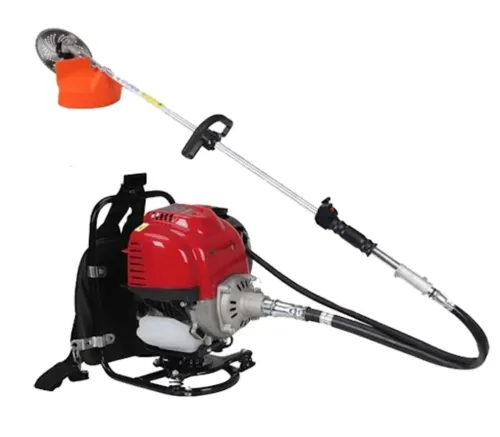
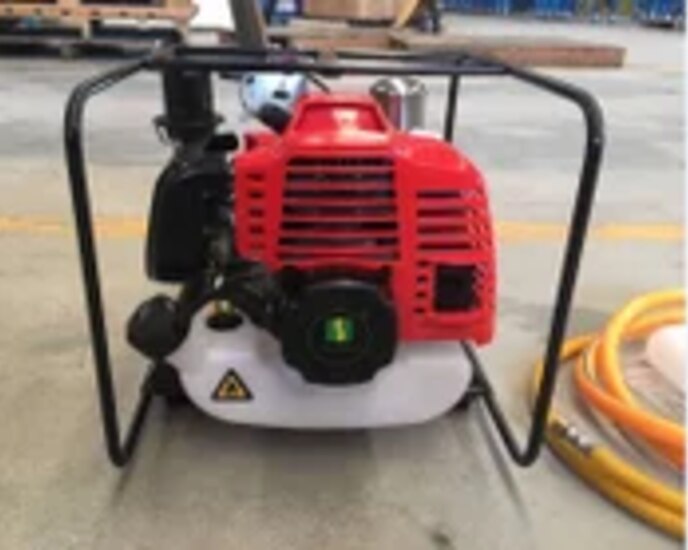
A heavy duty portable sprayer survives repeated work through construction, not an engine-size label. Choose a guarded frame, secure tank mounting, vibration isolation, chemical-compatible seals, a filter, and hose, lance and gun components built for the intended pressure. Confirm the engine’s intermittent or continuous duty cycle and access to service parts before buying.
| Pump type | Strength | Watch for |
|---|---|---|
| Diaphragm pump | Chemical isolation and broad formulation tolerance | Confirm diaphragm, seal and cleaning compatibility |
| Piston pump | High pressure with moderate flow | Pulsation, seal wear and contaminated water |
| Plunger pump | High pressure and durable output | Needs filtration, a pulsation damper and safe bypass protection |
Maximum pressure is not useful working pressure. Request flow at the intended pressure measured near the nozzle manifold, after losses through the hose, filter, regulator, gun, nozzle and agitation circuit. Tank agitation consumes flow; a pump sized only for one gun can lose pressure when recirculating or feeding a second outlet.
A 25cc, 35cc, 39cc or 42.7cc engine does not predict area per hour. Match it to hose diameter and length, elevation, terrain, nozzle demand, agitation and workload continuity.
- Duty-cycle guidance and pressure-flow data
- Replacement parts, warranty and local service
- Noise, vibration and emissions information
- Maximum hose length and seal materials
- A bypass that protects the pump from closed-discharge operation
How to match pressure, flow and nozzles to the job
Choose the nozzle before adjusting spray pressure. Herbicide on weeds usually suits a flat-fan pattern aimed at uniform ground coverage; low-drift flat-fan nozzles produce larger droplets when drift risk matters. Air-induction nozzles reduce drift further but may need different pressure and provide less fine-droplet coverage.
Hollow-cone nozzles penetrate dense orchard canopies for insecticide or fungicide, but their finer droplets drift more readily.
| Job | Nozzle choice | Setup priority |
|---|---|---|
| Herbicide, nursery rows, garden beds | Flat-fan or low-drift flat-fan | Even overlap and controlled drift |
| Insecticide or fungicide in dense foliage | Hollow-cone | Penetration and complete wetting |
| Orchard canopy near sensitive areas | Air-induction or low-drift | Larger droplets and reduced drift |
| Wash-down work | Coarse, high-flow nozzle or gun | Flow and reach, not hectare rate |
For the same nozzle, doubling spray pressure raises nozzle flow by only about 41%, while increasing fine, drift-prone droplets. Pressure is not a substitute for nozzle selection. Excess volume causes runoff and product waste; too little leaves the target poorly wetted.
Use sprayer calibration to measure actual nozzle flow. Walk at a constant speed, collect output from every outlet for a timed interval, and compare each result with a new nozzle. Replace any nozzle differing by roughly 10% or more; raising pressure cannot correct uneven wear.
Check pressure at the nozzle manifold, because hose, filter and fitting losses separate pump output from application rate.
For example, four nozzles flowing 0.8 L/min each at 3 km/h across a 1.5 m swath apply 426.7 L/ha: 600 × 3.2 ÷ (3 × 1.5). Use the same equation for field work: application volume (L/ha) = 600 × total nozzle flow (L/min) ÷ [speed (km/h) × swath (m)].
How to estimate coverage, runtime and carrying effort
A sprayer coverage calculation starts with application rate, not pump capacity. For a 2-hectare plot requiring 300 litres per hectare, you need 600 litres of mixed spray; a 20-litre tank covers 0.067 hectares per refill.
- Calculate treated area per refill: tank volume ÷ litres per hectare.
- Calculate field capacity: speed (km/h) × swath (m) ÷ 10 = hectares per hour.
- Calculate spraying time: hectares ÷ field capacity, then add refill, turning and hose-moving time.
- Calculate refills: total litres required ÷ usable tank volume, rounding up.
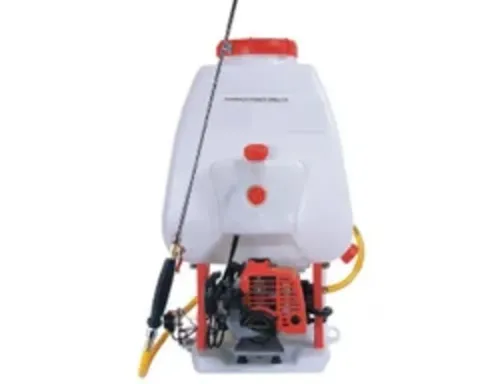
A full 20-litre tank adds about 20 kilograms before the tank, engine and frame are counted. The load lightens as spraying progresses, but a heavy knapsack sprayer still increases fatigue and reduces stability on slopes, long rows and uneven ground.
| Option | Main trade-off | Suitable work |
|---|---|---|
| Petrol portable | Reach and continuous output, but noise, emissions and servicing | Larger dispersed areas and long hose runs |
| Battery or manual | Quieter and lighter, with less reach or runtime | Small, quiet sites and short treatments |
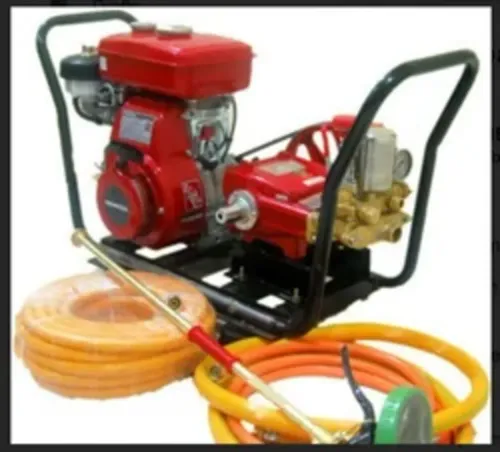
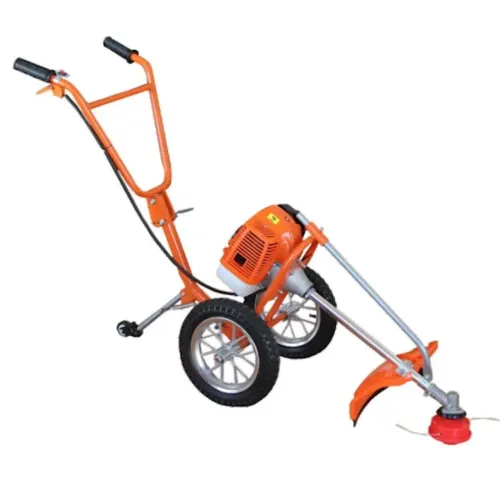
| Wheeled or tractor-mounted | Less carrying effort, but needs access and turning space | Repeated large-area work |
| Mist blower | Air-assisted reach, but poorer controlled liquid placement | Canopies needing reach, not precise ground application |
Choose a wheeled or tractor-mounted unit for repeated large fields. Use a battery or manual sprayer near homes, gardens or small plots. Do not use a mist blower where liquid must land precisely.
Confirm petrol type, oil specification, fuel-tank capacity, consumption and sprayer runtime from the manufacturer. Never invent area-per-tank figures.
How to mix, spray, clean and maintain the machine safely
1. Read the pesticide label before mixing: follow its mixing order, PPE, re-entry interval, wind limit, spray-zone protection and disposal rules. Wear chemical-resistant gloves, eye protection, long sleeves and the specified respirator. Check chemical compatibility for the diaphragm, seals, hose and tank with wettable powders, suspension concentrates, emulsifiable concentrates, herbicides, fungicides, insecticides and fertiliser solutions.
2. Fill the tank one-third to one-half with clean water, start agitation, then add measured concentrate in the label’s order. Use a jar test with hard or alkaline water: combine the same water and products in small proportions, then reject any mixture that gels, separates or forms sediment.
Filtration protects nozzles, but agitation consumes pump flow, so recirculation can reduce gun pressure.
3. Spray only within the label’s weather limits. Use the nozzle’s recommended droplet size, keep the gun or boom as low as practical, hold the nozzle orientation correctly and avoid excess pressure. Stop during gusts, temperature inversions, or hot, dry conditions; fine droplets and vapour can leave the target even after accurate calibration.
4. For tank cleaning, drain completely, rinse the tank, suction line, pump, hose, gun and return circuit, then circulate the label-specified cleaning solution. Remove and clean filters and nozzles separately. Apply rinsate to a labelled treatment area when permitted; never pour it into drains, soil or water.
5. Sprayer maintenance includes the air filter, spark plug, specified pump oil, fuel storage, winter storage, hoses and seals. A blocked nozzle calls for cleaning; cavitation calls for checking water level, suction leaks and the inlet filter; pressure loss calls for filters, bypass and worn seals.
Hard starting points to fuel, plug or air-filter checks; overheating points to cooling airflow and overload. Never run a high-pressure pump against a closed discharge without a safe bypass.
When a heavy-duty portable sprayer is the right farm or garden choice
Choose a petrol sprayer only after measuring the job, not the engine. Your portable sprayer buying guide should record treated area, terrain, target height, hose distance, required spray volume, water access, refill route, operator carrying distance, acceptable noise and whether use is occasional or commercial.
Use this sprayer selection checklist before comparing models:
- Ask for working pressure and flow at the nozzle manifold, nozzle sizes and recommendations, timed-output guidance, maximum hose length and agitation flow.
- Confirm petrol type, oil specification, tank capacity, expected consumption, starting procedure, sound level, vibration, emissions compliance, and the seal and hose materials approved for your chemical.
- Check parts availability, warranty terms and local sprayer service support. Importers of Agricultural Equipments in Bangalore can provide model-specific operating details, but verify every figure against the chemical, nozzle and workload.
Petrol portable units are the wrong choice indoors or in enclosed spaces, at noise-sensitive sites, on very small treatment areas, or where precise low-volume delivery matters more than reach. Do not carry a full tank across steep or uneven ground if the load creates unacceptable fatigue or instability.
| Option | Best fit | Main limitation |
|---|---|---|
| Petrol portable | Long rows, moderate hose reach, occasional commercial work | Noise, emissions, fuel and carrying fatigue |
| Battery or manual | Small, quiet garden areas and precise spot treatment | Limited runtime, pressure or output |
| Wheeled or tractor-mounted | Repeated large-area spraying | Needs vehicle or clear access |
Choose by flow at working pressure, hose losses and stable support, not engine displacement alone.
Related products
 | PORTABLE POWER SPRAYERS Engine Type: Air Cooled, 4 Stroke Engine Displacement: 25cc Pump Pressure: 15-25kg/cm Discharge: 5-8Lpm View product → |
 | PORTABLE POWER SPRAYERS Engine Type: Air Cooled, 4 Stroke Engine Displacement: 35cc Pump Pressure: 15-25kg/cm Discharge: 5-8Lpm View product → |
Frequently asked questions
What makes a portable sprayer heavy duty in field use?
Look for a guarded frame, secure tank mounting, vibration isolation, chemical-compatible seals, a filter, and hose, lance and gun components rated for the intended pressure. Check the engine duty cycle and service-part availability.
How do you match pressure, flow and nozzles to a spraying job?
Select pressure and nozzle type according to the target, crop or surface, desired droplet size and application rate. Use the nozzle flow rate, travel speed and spray width to confirm coverage instead of relying on pressure alone.
How can you estimate sprayer coverage, runtime and carrying effort?
Estimate area per tank from tank volume and application rate, then calculate runtime from fuel capacity and engine consumption. Include the filled tank, frame and hose when assessing the weight you must carry.
How should you mix, spray, clean and maintain a portable sprayer safely?
Wear the label-specified protective equipment, measure chemicals accurately, fill in the correct order, inspect for leaks, and keep people away from the spray area. After spraying, rinse the tank and flush the hose, gun, lance, filter and nozzle with clean water before storage.
When is a heavy-duty portable sprayer the right choice?
Choose one when fields or gardens lack vehicle access, work is repeated, and you need controlled application from a mobile unit. Compare it with trolley, tractor-mounted and backpack sprayers when load weight, area size or terrain changes the practical choice.
Related products
 | PORTABLE POWER SPRAYERS Engine Type: Air Cooled, 2 Stroke Engine Displacement: 34cc Pump Pressure: 15-25kg/cm² Discharge: 5-8Lpm View product → |
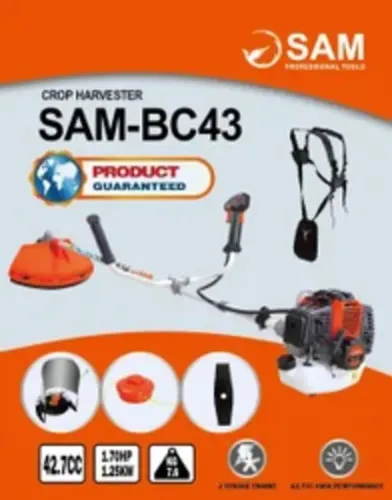
 | PORTABLE POWER SPRAYERS Engine Type: Air Cooled, 2 Stroke Engine Power: 1.25kw/1.7HP Engine Displacement: 42.7cc Pump Pressure: 35kg/cm² Discharge: 5-15Lpm View product → |
 | KNAPSACK POWER SPRAYERS Engine Type: Air Cooled, 4 Stroke Engine Displacement: 39cc Tank Capacity: 20Ltr Discharge: 3-8Lpm Pressure: 15-25 Kg/cm² Weight: 11kg View product → |