Choose a wheel brush cutter by the stems, terrain and obstacles it must handle—not by acreage alone. By comparing vegetation, ground conditions, production rate and competing machines, you can decide whether a walk-behind cutter is the right tool for the site and plan the clearing work without overstating its capacity.
Key takeaways
- Choose by stem toughness, density and height—not acreage alone.
- Check slopes, obstacles, transport routes and ground conditions before buying.
- Estimate real output using turning, refuelling and obstruction time.
- Compare cutting heads, site preparation and ownership costs with alternatives.
Start with the vegetation, not the acreage
Choose a wheel brush cutter when the vegetation makes a handheld tool slow and a conventional mower unreliable. Tall grass and dense weeds that resist a steady walking pace, wrap beneath a deck or include tough stems justify the change.
Wheel support reduces fatigue, while self-propelled drive maintains progress when wet material packs under the cutting deck.
For large scale grass clearing, look for these signs:
- The growth forms a continuous cover across verges, vacant lots, orchard rows or drainage margins rather than isolated patches.
- Stems are too tough or numerous for efficient line trimming, yet the site does not require a tractor-mounted cutter.
- You need a consistent cutting height over long runs and cannot sustain several hours of carrying a handheld machine.
- Fixed obstacles are limited and visible, leaving enough room to steer between passes.
- The machine offers low-speed control or variable travel speed, not just a fast transport setting.
A handheld brush cutter remains the better choice around dense tree growth, fencing, irrigation lines, rocks and irregular edges. A mower suits short, maintained grass on firm, even ground; it becomes a poor choice when tall growth clogs the deck or woody stems strike the blade.
A wheel brush cutter is not automatically the best answer for very large, open acreage: a tractor-mounted rotary cutter or tow-behind brush mower usually covers more ground per pass.
Wheels also do not remove slope risk. Check the stated limits for uphill, downhill and side-slope operation before treating wheel support as a safety advantage.
Match the machine to the ground and access
A wheel brush cutter works best on firm, reasonably level ground where the operator can make long passes without frequent stops or sharp turns. The wheels carry machine weight, but they do not prevent a rollover on a slope or stop the blade from striking a hidden object.
Look for a site with:
- Continuous grass or weed growth across open plots, roadside verges, vacant lots or drainage margins
- Access wide enough for the machine and its cutting deck
- Turning space at field edges and around gateways
- Few trees, fence posts, irrigation lines, stumps and exposed roots
Check the manufacturer’s maximum slope before entering the site. Distinguish uphill and downhill travel from side-slope operation; a machine that climbs a stated gradient can still slide or overturn when driven across it. Wet grass increases slip, while soft soil and mud can make the wheels sink, reduce steering control and leave ruts.
Stones and ruts create a second risk. They can lift the deck, deflect a blade or stop one wheel suddenly, so walk the area and remove loose rocks before cutting. Mark fixed hazards that cannot be removed.
Steps, steep drainage banks and narrow passages between trees suit a handheld cutter better. Choose a wheel machine where access is continuous and the surface supports its weight; otherwise, repeated repositioning erases the fatigue and productivity advantage of the wheels.
Estimate practical output before choosing cutting width
A 28-inch cutter travelling at 2 mph has a theoretical capacity of about 0.57 acres per hour. After allowing for turns, overlap, obstacle avoidance and jam clearing, 60–75% field efficiency produces roughly 0.34–0.43 acres per hour, or 2.7–3.4 acres in eight hours of actual cutting.
Use this calculation before paying for extra cutting width:
Effective width × forward speed × field efficiency = practical acres per hour
A self-propelled drive helps maintain a steady pace, but it cannot overcome dense stems, rough ground or repeated manoeuvring. Record the time spent cutting, turning and clearing obstructions on a representative test area.
| Machine choice | Practical output implication | When it fits |
|---|---|---|
| 28-inch wheel cutter | About 0.34–0.43 acres per hour at 2 mph and 60–75% efficiency | Irregular plots, verges and obstacle-filled ground |
| Wider wheel cutter | Higher theoretical capacity, but gains shrink when speed falls or overlap increases | Open ground with few trees, posts, rocks or tight turns |
| Tractor-mounted or tow-behind cutter | Much greater width and forward capacity | Large, open acreage with suitable vehicle access |
A wider deck fails to improve production when trees, fence posts, rocks and irrigation lines force repeated detours. It also meets more material per pass, which can slow travel, overload the belt or cause blade stoppages.
Choose the smallest width that clears the site without constant reversing or overlap. If the plot is broad and unobstructed, compare the result with a tractor-mounted rotary cutter before selecting a wheel machine.
Select the cutting system and prepare the site
Use a line head for soft grass and light weeds, a grass blade for dense grass, and a brush knife or metal clearing blade for tougher stems.
Choose only a head listed for the machine; fitting a heavier blade than the guard, spindle and drive are rated to handle can cause belt damage, blade stoppage or driveline shock.
| Option | Best use | Main limitation |
|---|---|---|
| Line head | Grass, weeds and light vegetation around obstacles | Leaves a rough finish and can eject line fragments |
| Grass blade | Dense, tall grass on open ground | Struggles with woody stems and hidden metal |
| Brush knife | Repeated weeds and thin woody growth | Needs greater guarding and careful object inspection |
| Metal clearing blade | Brush and saplings within the stated diameter rating | A near-limit stem is not a safe routine target |
Do not treat the published maximum stem diameter as your working target. Frequent saplings call for a heavier blade carrier, protected spindle and an explicit brush-cutting rating rather than a wider, light-duty deck.
Before starting, walk the entire route and remove or mark:
- Wire, fencing, cable, hoses and irrigation heads
- Rocks, bottles, scrap metal and loose timber
- Stumps, exposed roots, drainage covers and survey stakes
- Posts, kerbs, tree trunks and other fixed obstacles
Use visible flags for objects you cannot remove. Confirm the deck has documented blade guarding, an operator-presence control and a way to stop blade rotation before leaving the controls. Expect cut stems and woody debris to remain; plan raking, collection, chipping or disposal instead of assuming the cutter leaves a lawn-like surface.
Compare the complete machine cost with other clearing options
A wheel brush cutter is the better business choice when access, ground pressure and operator control matter more than maximum cutting width. Compare the complete job cost: purchase or hire, transport, fuel, operator hours, maintenance, blade wear, downtime and any follow-up debris work.
| Option | Cost and productivity trade-off | Choose it when |
|---|---|---|
| Wheel brush cutter | Lower transport and access burden; pneumatic tires reduce operator fatigue, but output and cutting width are limited. | Verges, orchards, drainage margins and vacant lots have obstacles, narrow gates, irregular ground or soft soil. |
| Flail mower | Higher purchase, power and maintenance demands, but it chops vegetation more finely. | You need a cleaner finish and want to reduce raking, collection or a second mowing pass. |
| Tractor-mounted rotary cutter | Highest width and acreage output on suitable ground, with tractor, fuel and transport costs added. | Large open fields have few obstacles, firm access and continuous vegetation. |
| Excavator attachment | Expensive mobilisation, yet strong reach and control around heavy brush, banks and stumps. | The project also requires excavation, stump work or access where a wheeled cutter cannot operate safely. |
Do not compare horsepower alone. Ask Importers of Agricultural Equipments for the blade-carrier inspection points, belt or clutch service requirements, replacement blade availability and documented slope limits before pricing repeated work.
A wheel cutter loses its cost advantage when dense woody growth stalls it, hidden wire damages the cutting system, or cut stems require extensive disposal. Choose the flail mower for finish quality, the tractor-mounted rotary cutter for open acreage, and the excavator attachment for reach and heavy ground work.
Related product
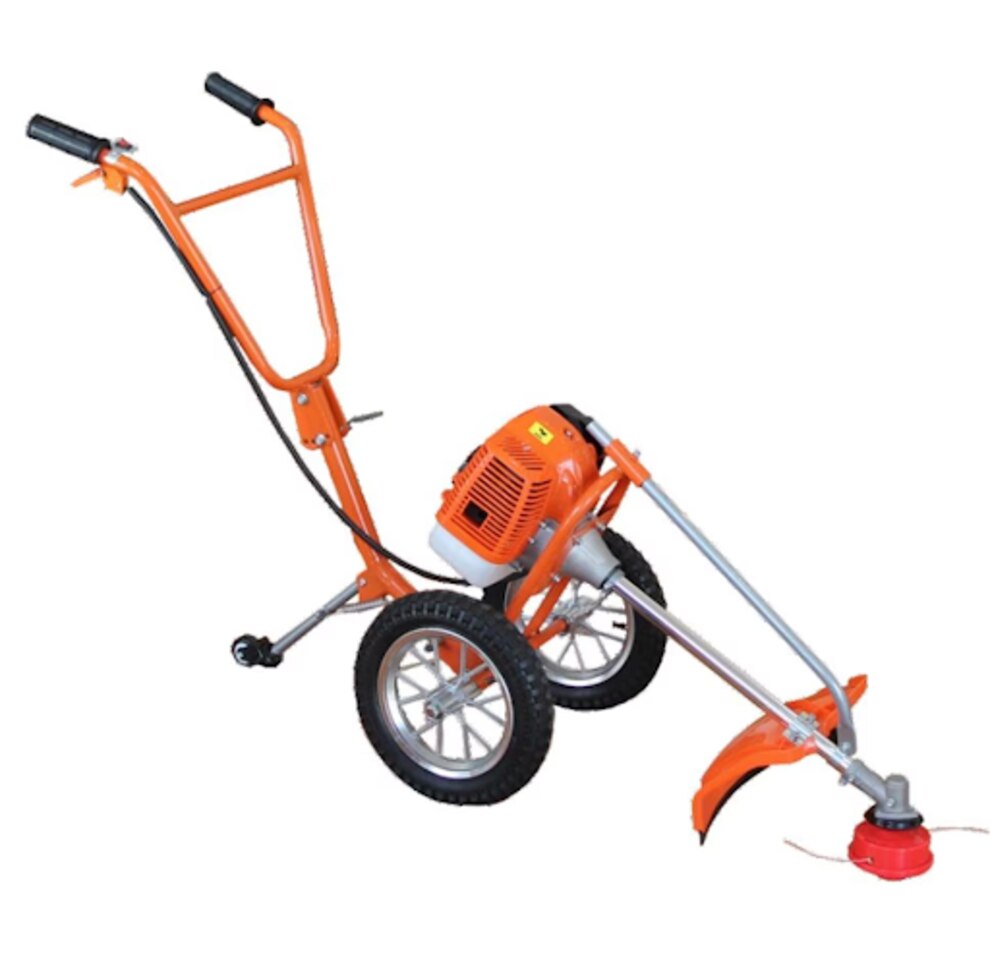
 | GASOLINE BRUSH CUTTER SAM 2 Stroke Wheel Brush Cutter Engine Type: Air Cooled, 2 Stroke Engine Power: 1.4kw/1.9HP Engine Displacement: 51.7cc Fuel Tank Capacity: 1.1Ltr Weight: 10kg View product → |
Frequently asked questions
How do you decide whether a wheel brush cutter suits the vegetation?
Assess grass height, weed density, stem toughness and whether the vegetation wraps under a conventional mower deck or slows handheld cutting.
What ground and access conditions should you check first?
Check slopes, uneven ground, wet areas, obstacles, gates, paths and transport access before selecting a wheel brush cutter.
How should you estimate a wheel brush cutter’s practical output?
Allow for turns, refuelling, clearing obstacles and site preparation instead of calculating output from cutting width alone.
What costs should you compare with other clearing options?
Compare the complete machine cost, cutting-system needs, preparation work, labour, fuel, maintenance and transport against alternative clearing methods.