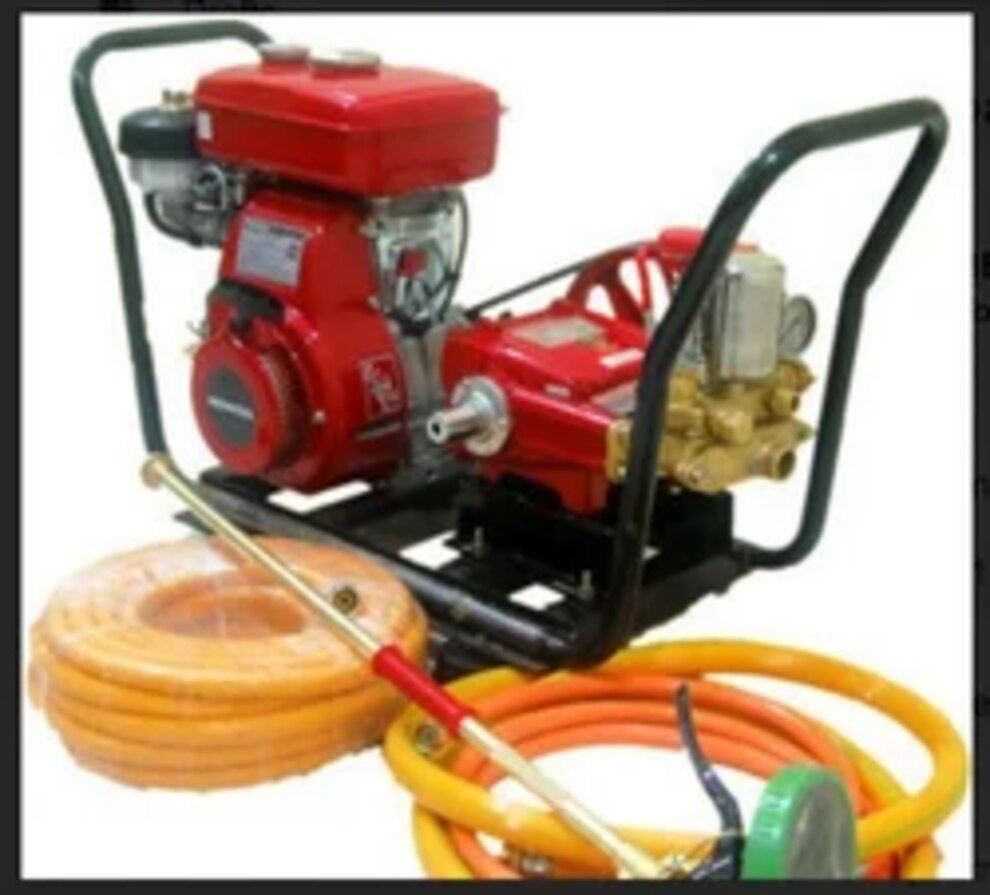
A pressure rating on a pump does not guarantee steady pressure at the nozzle. You will learn how the pump, regulator, bypass line, hose, nozzle and engine speed work as one system, then how to set, diagnose and calibrate that system for the required field application rate.
Key takeaways
- Use the bypass regulator to return excess flow and stabilise pressure.
- Treat rated maximum pressure as a pump limit, not nozzle pressure.
- Check filters, hoses, seals and engine speed when pressure fluctuates.
- Calibrate nozzle output at the working pressure before spraying.
How the Pump and Bypass Valve Hold Spraying Pressure
A power sprayer with pump does not hold a set pressure by itself. The pump supplies flow, while a pressure regulator controls where that flow goes when nozzle demand changes.
The control loop works in three steps:
- With all nozzles operating, the regulator allows enough flow to reach the boom while maintaining the selected pressure.
- If a section closes or a nozzle delivers less flow, the bypass valve diverts surplus liquid back to the tank or into the pump circuit. Pressure does not rise sharply because the excess has somewhere to go.
- If the system uses an unloader valve, it unloads or recirculates pump flow when discharge demand falls, reducing stress on a positive-displacement pump.
Opening additional sections reverses the balance: more pump flow reaches the nozzles, and less returns through the bypass. Pressure still falls if the nozzles, agitation circuit and plumbing require more flow than the pump can produce at the selected engine or PTO speed.
Keep that speed steady. A fixed-displacement pump delivers less flow when shaft speed drops, while a centrifugal pump shifts its pressure-flow operating point.
A pump-mounted gauge can show more pressure than reaches the nozzle because hoses, filters, valves and section plumbing consume pressure through friction. Stable pressure at the regulator therefore does not prove uniform nozzle output; confirm performance at the boom or by measuring nozzle flow.
Why Rated Maximum Pressure Is Not Nozzle Pressure
Rated maximum pressure is a pump’s upper operating limit, not the nozzle pressure during spraying. A catalogue rating is recorded under stated conditions such as shaft speed, liquid flow and regulator setting. It does not include the losses created by the sprayer’s actual plumbing.
A pump-mounted pressure gauge measures pressure at the pump or regulator. As liquid travels through a filter, hose, valve, boom and section fittings, hose friction loss and other restrictions consume part of that pressure.
The pressure gauge can therefore show 20 bar while only 16 bar reaches the boom, depending on hose length, internal diameter, flow rate and cleanliness.
| Reading source | What it represents | Why it differs from nozzle pressure |
|---|---|---|
| Catalogue rating | Rated maximum pressure under test conditions | It is a limit, not the pressure delivered through your complete spray circuit |
| Pump-mounted gauge | Pressure near the regulator | It excludes downstream friction loss through filters, hoses, valves and boom plumbing |
| Boom gauge | Pressure close to the nozzles | It gives a more useful setting for actual nozzle pressure |
| Nozzle output check | Flow discharged by the nozzle | It confirms performance when gauge readings are damped or misleading |
Reciprocating diaphragm and piston pumps also create rapid pulsations. A liquid-filled pressure gauge can hide those fluctuations while nozzles receive cyclic flow; an air chamber or pulsation dampener reduces the variation but cannot repair restricted suction or inadequate pump capacity.
Set spraying pressure from a boom-mounted gauge when available, then verify nozzle flow against the nozzle’s rated output. Do not use the catalogue’s rated maximum pressure as the calibration target.
How to Set Pressure and Find the Cause of Fluctuation
Stable pressure starts with a stable drive speed. Fill the tank, start the engine, and hold the specified engine RPM or PTO speed before opening the spray line. Adjust the regulator until the gauge reaches the working setting, then collect liquid from a nozzle for a timed interval; compare that output with the nozzle specification.
- Confirm that pump capacity covers nozzle demand plus agitation or bypass flow. Opening boom sections or increasing agitation will lower pressure if total demand approaches the pump’s available flow.
- Clean the suction filter and strainer, inspect the suction hose for collapse, and tighten fittings that could admit air.
- Check the liquid level and prime the pump before adjusting the regulator. A regulator cannot correct cavitation or a lost prime.
- Fit and correctly charge the air chamber or pulsation dampener on a diaphragm or piston pump, then set the regulator.
- Inspect each nozzle for wear, debris, and a blocked nozzle. Replace worn nozzles rather than raising pressure to compensate.
| Symptom | Likely cause | Corrective check |
|---|---|---|
| Pressure falls when sections open | Insufficient pump flow at the selected speed | Increase engine RPM or PTO speed only to the specified limit, reduce demand, or use a higher-capacity pump |
| Gauge pulses rapidly | Pulsation, air entry, or cavitation | Check the dampener, suction filter, fittings, hose, and liquid level |
| One spray pattern differs | Worn or blocked nozzle | Clean it, then compare timed output with a new-nozzle specification |
| Pressure wanders after adjustment | Unstable drive speed or regulator fault | Hold shaft speed constant and inspect the regulator seat and spring |
Why Nozzle Choice and Calibration Matter More Than Pressure Alone
Two sprayers at the same pressure can apply different rates because nozzle design, nozzle flow rate, travel speed and boom height control how liquid reaches the crop. Calculate application rate with: litres per hectare = 600 × nozzle flow in litres per minute ÷ (speed in kilometres per hour × nozzle spacing in metres).
Increase speed without changing flow, and the field receives less product.
| Nozzle type | Spray characteristic | Suitable use |
|---|---|---|
| Flat-fan nozzle | Even fan-shaped sheet with overlapping patterns | Uniform boom spraying at a verified height |
| Hollow-cone nozzle | Concentrated, fine droplets with strong coverage inside foliage | Directed coverage where drift conditions permit |
| Adjustable-lance nozzle | Hand-set stream or cone whose output changes with adjustment | Spot treatment, not a consistent boom rate |
Boom height determines pattern overlap. Set it too low and untreated strips appear between passes; set it too high and droplets drift while adjacent patterns overlap excessively. A nozzle’s pressure-flow relationship is limited: quadrupling pressure doubles flow, so pressure is a poor replacement for changing nozzle size.
Calibrate with the equipment moving at its working speed. Collect each nozzle’s output for a timed interval, compare it with the new-nozzle specification, and replace nozzles that differ materially. Abrasive products enlarge or distort orifices, increasing flow without an obvious pressure change.
Confirm pressure at the boom, not only at a pump-mounted gauge, because hose, filter and valve losses reduce nozzle pressure.
What to Check When Choosing and Maintaining a Sprayer System
Choose equipment with enough pump capacity for nozzle demand plus agitation and bypass flow. If total flow approaches the pump’s output at the specified engine or PTO speed, pressure will drop when you open another section or increase tank agitation.
| Feature | What to verify | Failure prevented |
|---|---|---|
| Pump capacity | Actual flow at working engine or PTO speed, not only catalogue maximum pressure | Pressure loss when demand rises |
| Regulator and bypass valve | Adjustable regulator returns surplus flow to the tank or recirculates it | Unstable pressure and positive-displacement pump overload |
| Pulsation dampener or air chamber | Correct size, sound diaphragm and specified air charge | Gauge flutter and uneven nozzle output |
| Pressure gauge | Gauge installed near the boom or spray line and readable at working pressure | Mistaking pump pressure for nozzle pressure |
| Speed control | Engine throttle or PTO rpm can remain at the specified setting | Flow changes caused by shaft-speed variation |
A pulsation dampener or air chamber reduces the discharge pulses from piston and diaphragm pumps; it cannot repair a blocked suction line or an undersized pump. Ask Importers of Agricultural Equipments to confirm usable flow at your intended rpm and with bypass demand included, rather than choosing from maximum pressure alone.
- Clean the suction strainer, filter and nozzle screens before each spraying job.
- Compare collected nozzle output with the new-nozzle specification; abrasive mixtures enlarge or distort orifices, so nozzle wear can escape a pressure-only check.
- Replace damaged hoses, leaking seals and stiff regulator parts before calibration.
- Recheck output after changing nozzle spacing, boom height, travel speed or engine speed. Stable pressure does not prove a uniform application rate.
Related products
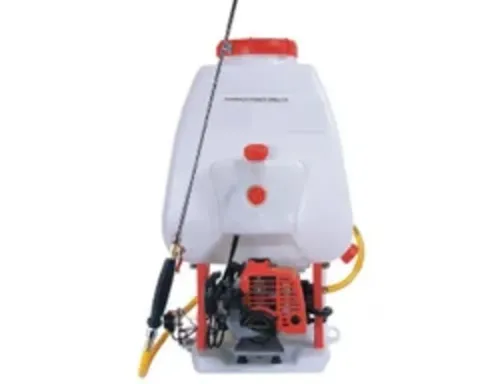
 | KNAPSACK POWER SPRAYERS Engine Type: Air Cooled, 4 Stroke Engine Displacement: 39cc Tank Capacity: 20Ltr Discharge: 3-8Lpm Pressure: 15-25 Kg/cm² Weight: 11kg View product → |
 | PORTABLE POWER SPRAYERS Engine Type: Air Cooled, 2 Stroke Engine Power: 1.25kw/1.7HP Engine Displacement: 42.7cc Pump Pressure: 35kg/cm² Discharge: 5-15Lpm View product → |
Frequently asked questions
How does a pump and bypass valve maintain spraying pressure?
The pump supplies flow, while the pressure regulator or bypass valve redirects excess flow when nozzle demand falls. This prevents pressure from rising as long as the system is correctly adjusted.
Why is rated maximum pressure different from nozzle pressure?
Rated maximum pressure is the pump’s operating limit under specified conditions. Nozzle pressure depends on the regulator setting, hose losses, filter condition and flow demand at the boom or spray gun.
What causes pressure fluctuation in an agricultural sprayer?
Inspect the inlet filter, suction hose, pump seals, air leaks, regulator, discharge filter and engine speed. A blocked nozzle or a regulator that sticks can also cause cycling pressure.
How do nozzle choice and calibration affect spraying?
Nozzle size, spray angle, spacing, travel speed and working pressure determine application rate and droplet size. Measure nozzle output at the intended pressure instead of relying on pressure alone.
What should you check before choosing or maintaining a sprayer system?
Compare required flow, working pressure, pump capacity, regulator range, hose size, filter mesh and nozzle compatibility. Maintain clean filters, leak-free connections and calibrated nozzles.
Related products
 | PORTABLE POWER SPRAYERS Engine Type: Air Cooled, 2 Stroke Engine Displacement: 34cc Pump Pressure: 15-25kg/cm² Discharge: 5-8Lpm View product → |
 | PORTABLE POWER SPRAYERS Engine Type: Air Cooled, 4 Stroke Engine Displacement: 35cc Pump Pressure: 15-25kg/cm Discharge: 5-8Lpm View product → |
 | PORTABLE POWER SPRAYERS Engine Type: Air Cooled, 4 Stroke Engine Displacement: 25cc Pump Pressure: 15-25kg/cm Discharge: 5-8Lpm View product → |
 | HTP PUMPS Required Power: 2-5HP Discharge: 30-40LPM Pressure: 20-45 kg/cm² Required RPM: 1000-1200 View product → |