The right chainsaw depends on the tree, branch diameter, cutting position, work frequency and your ability to control the saw—not simply on engine size or advertised bar length. By the end, you will be able to specify a suitable saw, compare petrol and battery models, reject unsafe formats and assess the maintenance and protective equipment required.
Key takeaways
- Choose a rear-handle saw for ground-based pruning, felling and bucking.
- Match guide-bar length to trunk diameter and required cutting clearance.
- Compare fuel, battery and electric models by runtime, maintenance and access to power.
- Inspect the chain brake, throttle lock, bar, chain and safety documentation before buying.
Match the saw format to the work position and tree size
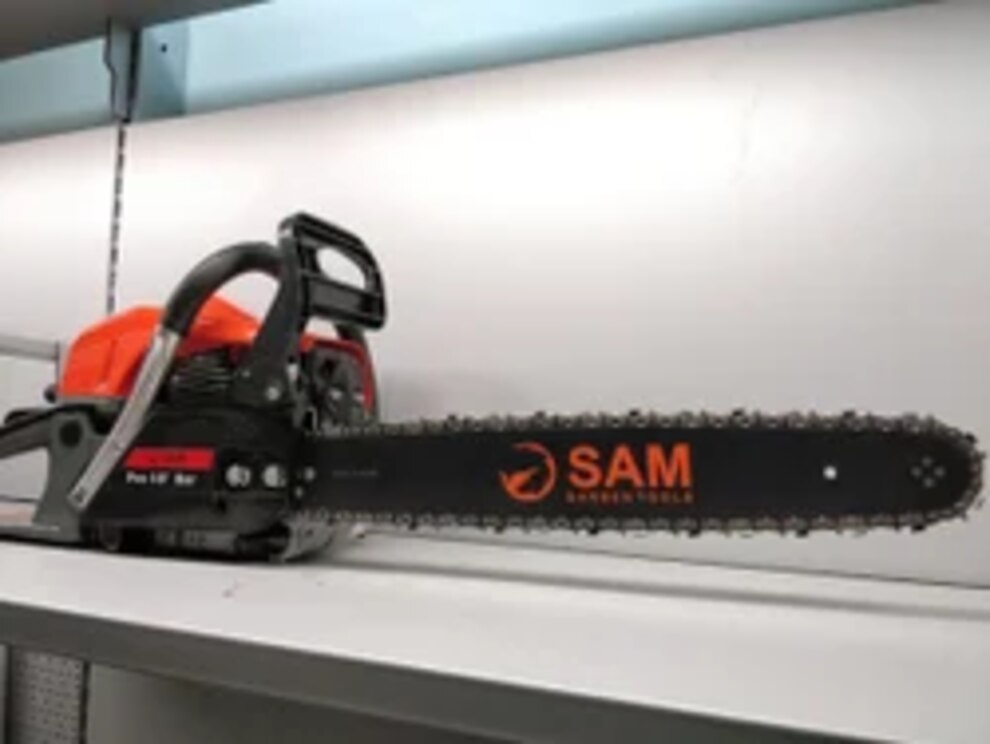
For most farm work, choose a rear-handle chainsaw: it gives a ground operator stable two-handed control for low-branch pruning, felling and bucking. Select the format before choosing engine size or guide-bar length.
| Option | Best fit | Avoid or limitation |
|---|---|---|
| Top-handle arborist chainsaw | Trained tree-service operators pruning from the canopy | Not a lighter general-purpose saw; do not use it for routine ground cutting |
| Rear-handle chainsaw | Ground pruning, small-tree felling, firewood bucking and daily farm maintenance | Poor choice when you need canopy access without climbing equipment |
| Pole saw | Selected overhead branches cut from the ground | Its reach worsens balance and kickback control; it is not a substitute for climbing practice or a top-handle saw |
| Professional felling saw | Larger stems, directional felling and repeated bucking by experienced operators | Excess weight and power make it unsuitable for casual pruning or light maintenance |
Use a pole saw when staying on the ground removes the need to work beneath a branch. Stop and change methods when the branch is beyond controlled reach, the tree is unstable or the cut requires climbing and rigging.
ISO 11681 distinguishes general-purpose portable chainsaws from tree-service chainsaws, reflecting different hazards and intended users. For felling or bucking, choose the shortest bar that covers your normal trunk diameter; an unnecessarily long bar adds weight and nose leverage.
Choose guide-bar length, power and chain specification together
Choose a guide-bar length that covers the target diameter with working clearance, then match it to engine power, torque and chain speed. The effective cutting length is shorter than the advertised bar length because the powerhead and sprocket area cannot cut; compare the manufacturer’s stated figure, not the nominal bar size alone.
A bar that barely reaches the trunk forces awkward repositioning, while an unnecessarily long bar adds weight, nose leverage and cutting load.
| Work type | Bar and clearance | Power behaviour | Chain specification |
|---|---|---|---|
| Pruning and light limbing | Short bar sized to the branch range; keep the saw light and controllable | Moderate output with adequate chain speed prevents dragging through small wood | Narrow-kerf chain can reduce load, but match its pitch and gauge to the bar and sprocket |
| Routine farm bucking | Use the shortest bar whose effective cutting length clears normal logs; cut from both sides when required | Balance engine power, torque and fully equipped weight; excess bar length can cause bogging | Match pitch, gauge, drive-link count and nose sprocket |
| Large-diameter trunks | Select a longer bar only when its effective length and cutting clearance justify it | Higher rated engine power and torque hold chain speed in the cut | Use the bar maker’s specified chain and sprocket combination |
For engine-powered saws, compare rated power, dry weight, fuel-tank capacity and starting system together. Add the bar, chain, fluids and cover before judging power-to-weight performance. Stale fuel, a blocked air filter or a dull chain can make a large engine feel weak, while crop residue in the cooling intake can cause overheating.
Build safety into the saw choice and cutting method
Choose safety features and work conditions before cutting speed: reject a saw without a chain brake, inertia brake, throttle lockout, front hand guard and chain catcher.
1. Inspect the operator protection. Use a helmet with eye or face protection, hearing protection, chainsaw trousers or chaps, cut-resistant gloves and boots with ankle support and non-slip soles. Replace torn protective fabric or damaged visors before work.
2. Test every control with the engine stopped and then at idle. The chain must stop when you release the throttle; the throttle lockout must prevent accidental acceleration. Engage the chain brake and confirm that it stops the chain, then release it before cutting. Check that the stop switch works.
3. Control the kickback zone. Hold the saw with both hands, keep your left thumb wrapped around the front handle, and avoid contact between the upper quadrant of the bar nose and wood. A low-kickback chain and reduced-kickback bar lower the risk but cannot prevent kickback.
Do not use a top-handle arborist saw from the ground unless its intended use and your training match it.
4. Clear the site before starting. Keep people and animals outside the work zone, identify overhead lines, remove trip hazards, and establish an escape path before felling. Stop on unstable ground, poor visibility, high wind, icy surfaces or when lodged branches could fall unpredictably.
Never cut while standing on a ladder or from an unsafe platform.
Compare fuel, battery and electric ownership costs
A fuel saw suits long, remote cutting sessions when you can carry fuel and accept more servicing. Compare manufacturer-rated power, dry weight, fuel-tank capacity and starting system together; two-stroke fuel mixing, stale fuel, blocked air filters and a dull chain can erase the advantage of a larger engine.
| Power source | Runtime and ownership burden | Best workload |
|---|---|---|
| Fuel | Longest continuous runtime with refuelling; requires two-stroke fuel mixing, filter and spark-plug service, and fuel management. | Remote felling, bucking and heavy farm work where high output matters more than noise or routine maintenance. |
| Battery | Compare battery watt-hours (voltage × ampere-hours), charger time and tested cuts per charge. Buy enough charged packs for continuous work and budget for replacement batteries. | Pruning, limbing and shorter maintenance rounds where low noise, easy starting and reduced servicing improve daily productivity. |
| Corded electric | Low operating and maintenance cost, with no fuel or battery replacement. Extension-cord limitations restrict distance, create snag hazards and reduce movement around trees. | Fixed-area work near a reliable outlet, not scattered fields or remote woodland. |
Treat chain servicing as a production cost. Confirm local access to replacement chains and files, then inspect access to the air filter, spark plug, clutch cover and tensioner. A battery saw also needs a practical battery compartment and shared packs; a fuel saw needs convenient refuelling.
Four-stroke oil belongs to four-stroke equipment, not the fuel mix of a two-stroke chainsaw. Weigh the fully equipped saw, including bar, chain, fluids or battery, because extra mass increases fatigue during repeated cuts.
Use a purchase and inspection checklist before you commit
A productive saw has more than adequate power: it has matching parts, quick cleaning and local support. Confirm the chain pitch, gauge, drive-link count and nose-sprocket specification as a set; “3/8-inch chain” alone does not prove compatibility. Check that the replacement chain, files and bar are stocked nearby.
| Inspection point | Accept | Reject |
|---|---|---|
| Guide bar | Rails are straight, groove is clean and the bar-rail wear is even | Flared rails, a pinched groove or heavy nose wear |
| Chain tensioner | It moves smoothly and holds tension after tightening | It slips, binds or needs repeated adjustment |
| Oiler adjustment | Oil reaches the chain and the flow can be adjusted for the bar | No visible oil or a blocked oil outlet |
| Access | The clutch cover, air filter, spark plug and cooling fins open without awkward disassembly | Crop residue is trapped behind covers or service needs special tools |
| Power match | The engine or motor drives the chosen bar without bogging | A long bar overwhelms the power unit |
- Which exact chain part number, file diameter and drive sprocket fit this model?
- What is the service interval for the air filter, spark plug and clutch?
- Are chain, bar and sprocket replacements stocked in your district?
- Does the warranty cover agricultural dust and crop residue?
- Can you demonstrate chain-brake operation and explain the applicable safety standard?
- If you buy other field equipment from Importers of Agricultural Equipments, ask whether its service network can support this saw or supply compatible consumables.
Frequently asked questions
Which chainsaw format suits pruning, felling and farm maintenance?
Choose a rear-handle chainsaw for ground-based work such as low-branch pruning, felling and bucking. Do not use a top-handle saw from the ground unless its design and your training specifically permit it.
How do guide-bar length, power and chain specification work together?
Select a guide bar that suits the tree diameter, then confirm that the motor or engine can drive that bar and its matching chain pitch, gauge and drive-link count.
Which chainsaw safety features should you check?
Check for a chain brake, throttle lockout, hand guards, a chain catcher, anti-vibration features and a clearly marked stop control. Use the correct cutting method for the tree, branch and operator position.
Is a fuel, battery or electric chainsaw cheaper to own?
Compare fuel, oil, batteries, chargers, extension leads, maintenance and downtime alongside the purchase price. Fuel suits remote work, battery suits quieter short jobs and electric suits sites with dependable mains power.
What should you inspect before buying a chainsaw?
Confirm the saw's guide-bar compatibility, chain specification, safety controls, service support, spare-parts availability, warranty documents and operating manual before committing.