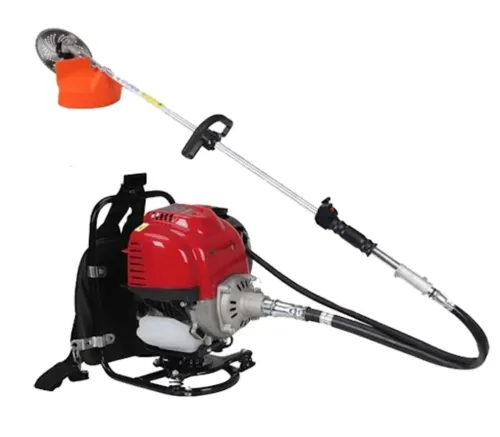

A sickle, machete or string trimmer can handle small patches, but uneven ground, woody weeds and dense stands quickly turn manual cutting into repeated effort. You will learn how to choose the right attachment, set a productive working pattern, avoid costly interruptions and compare machines by usable field output rather than engine size alone.
Key takeaways
- Use a brush cutter for tall grass, dense weeds, banks and rough ground.
- Choose nylon line for grass and a metal blade for woody growth.
- Clear around obstacles with short overlapping passes and a safety buffer.
- Compare fuel, maintenance and refuelling time before choosing two- or four-stroke power.
Where a Brush Cutter Saves Time Compared With Other Clearing Tools
A brush cutter saves most time on tall grass, dense weeds, thorny growth, saplings and uneven ground where hand tools require repeated strokes or a mower cannot travel safely. Its rotating attachment cuts a controlled swath while you walk, improving grass clearing and weed clearing across banks, rough margins and neglected plots.
| Tool | Most suitable work | Where a brush cutter is faster |
|---|---|---|
| Sickle | Short grass and small patches | Covers longer strips without constant bending and hand-driven strokes |
| Machete | Light brush, vines and isolated stems | Cuts continuous growth with less stopping, provided stems suit the attachment |
| Scythe | Tall grass on open ground | Handles thicker, wetter stands without the repeated sharpening and sweeping rhythm of manual cutting |
| String trimmer | Lawn edges, soft grass and delicate areas | Outpaces it in matted grass, woody weeds and dense overgrowth when fitted with a suitable blade |
| Walk-behind mower | Even, cleared lawns with few obstacles | Reaches slopes, ditches, tree bases, fence lines and ground hidden by stones or stumps |
Terrain determines the gain. A brush cutter follows uneven soil, narrow paths and sloping verges that force a mower to turn or leave uncut strips. Keep the attachment near parallel to the ground and take short, shallow bites; forcing dense stands can bog the engine, wind growth around the gearbox or leave incomplete cuts.
For a productive overgrowth clearing operation, inspect for wire, stones, irrigation pipes and hidden stumps first. Nylon line suits grass and soft weeds, while a correctly rated metal blade handles dense, matted or woody growth; a sharp blade often improves brush cutter efficiency more than a larger engine.
Match the Cutting Attachment to the Growth and the Ground
Choose the attachment by stem thickness, density and nearby hazards—not by engine size alone. The wrong blade can damage surfaces, eject debris or make the machine wrap before the engine sounds overloaded.
| Option | Best match | Main caution |
|---|---|---|
| Nylon line for grass | Lawn edges, tall grass, soft weeds and light herbaceous growth | Breaks against rocks, wire, fencing and tree trunks; keep people clear of flying fragments |
| 3-tooth brush cutter blade | Coarse grass and lighter weed growth in open ground | Stop before striking stones, concrete, posts or hidden wire |
| 8-tooth blade for weeds | Dense, matted weeds and tougher herbaceous stems | Use only with the guard, speed and blade size specified for your machine |
| Metal blade for brush | Woody weeds, thorny growth and small stems within the attachment rating | Kickback and contact damage rise; never substitute it for a saw blade unless the manufacturer permits it |
Use nylon near fences, walls, irrigation lines and tree trunks when its cutting capacity is sufficient. Choose a sharp metal blade for dense woody growth, because a dull or damaged blade increases vibration, forces harder pushing and leaves incomplete cuts. A saw blade is for sufficiently woody stems, not for skimming grass.
Inspect the guard, blade condition, harness and suspension point before work. Stop the engine, isolate the machine and wait for all movement to stop before removing vegetation wrapped around the gearbox, guard or shaft. Follow the machine and attachment manufacturer’s limits for every combination.
Use a Repeatable Clearing Method Around Obstacles
Treat this as a brush cutter safety method: make the site predictable before the cutting head starts turning. A repeatable sequence reduces thrown-object injuries and prevents rushed decisions beside property or people.
1. Inspect the whole area on foot. Identify people, pets, stones, wire, glass, irrigation pipes, sprinkler heads, tree trunks, fences, buildings and parked equipment. Move loose objects and equipment, close access points, and mark hazards hidden by grass.
2. Clear an escape route and establish a direction. Start in open ground, then work toward obstacles with debris directed into the already-cleared area, never toward people, windows, vehicles or livestock. Keep bystanders outside the exclusion zone specified in the machine manual.
3. Fit the approved guard and attachment for the vegetation and location. Use nylon line beside fences, tree bark, buildings and hard surfaces when the manufacturer permits it; use a metal blade only within its rated limits. Confirm that the blade, guard and handlebar match.
4. Set the brush cutter harness balance before cutting. Adjust the suspension point so the head floats at a consistent height without lifting the engine with your arms. Poor balance causes uneven stubble, missed weeds and early fatigue.
5. Cut narrow, manageable passes with controlled side-to-side movements. Approach trees and fences slowly, leave a protective margin rather than scraping bark or wire, and expose buried pipes by hand before cutting nearby.
6. Stop immediately if vegetation wraps around the head, gearbox or shaft, or if the attachment strikes a stone. Shut down and isolate the machine according to its manual before removing the material; then inspect the guard, blade and drive system before restarting.
7. Collect cut growth and inspect the ground again before opening the area to people or vehicles.
Increase Productive Output With Better Passes and Fewer Stops
Effective field capacity is the area you clear after losses, not the advertised brush cutter cutting width multiplied by maximum walking speed. Calculate it from usable width and steady travel speed, then allow for overlap, turns, obstacles, jams and stops; irregular sites can deliver far less than an open-field estimate.
Improve that capacity with these adjustments:
- Set cutting height just above the desired finish. Cutting too low makes the head strike soil and stones, while cutting too high leaves stems for repeated passes.
- Use a sweep width that matches the growth. A wide sweep covers more ground, but dense stems increase torque, slow walking speed and can bog the engine.
- Walk only as fast as the cutter completes a clean cut. Rushing creates missed strips; a controlled pace reduces repeated passes.
- Overlap each pass slightly so uncut strips do not force a second trip across the area.
- Keep a consistent direction and turn at the edge instead of making frequent corrective movements.
Fuel refuelling belongs in the work plan: stop at a boundary or natural break rather than after the tank empties mid-pass. Blade maintenance also controls output. Inspect the blade for cracks, bends and dull edges, then sharpen or replace it as specified; a damaged edge increases vibration, operator effort and incomplete cuts.
Clean air intake and cooling passages to prevent heat-related slowdowns.
Compare Two-Stroke and Four-Stroke Machines by Workday Cost
Fuel and downtime decide the workday cost more than peak power alone. A 2-stroke versus 4-stroke brush cutter comparison should include fuel handling, starting effort, operator fatigue and the vegetation being cut—not just engine size.
| Option | Workday advantage | Cost or risk to check |
|---|---|---|
| 2-stroke | Higher power-to-weight ratio suits thick weeds, woody stems and long cuts where carrying force matters. | Fuel mixing must match the maker’s oil-to-fuel ratio, fuel specification and ethanol limit. A wrong mixture can cause seizure, deposits, poor starting or reduced power. Noise and emissions also matter near buildings and livestock. |
| 4-stroke | Straight petrol avoids fuel mixing and can reduce preparation errors during repeated refuelling. Lower vibration, noise and emissions can make long work near people or animals less tiring. | Starting effort, service access and actual fuel consumption still need checking. Extra engine hardware is not automatically a higher workday cost. |
| Both | Select the attachment and guard for rocks, wire, fencing, glass and tree trunks; difficult vegetation increases line breakage, blade damage and debris risk. | Include replacement attachments, vibration control and cleaning access in the cost. Stop and isolate the machine before removing vegetation wrapped around the gearbox or shaft. |
For a 2-stroke, use one clearly labelled fresh fuel batch rather than guessing at the ratio in the field. For a 4-stroke, compare measured fuel use and refuelling time on the same vegetation. Importers of Agricultural Equipments can help you verify attachment compatibility and obtain service parts before a long contract.
Related products
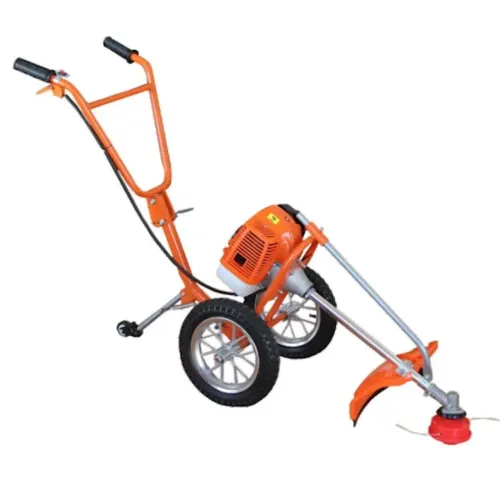
 | GASOLINE BRUSH CUTTER SAM 2 Stroke Wheel Brush Cutter Engine Type: Air Cooled, 2 Stroke Engine Power: 1.4kw/1.9HP Engine Displacement: 51.7cc Fuel Tank Capacity: 1.1Ltr Weight: 10kg View product → |
 | GASOLINE BRUSH CUTTER SAM-CGX-35 4 Stroke Backpack Brush Cutter Engine Type: Air Cooled, 4 Stroke Engine Power: 0.8kw / 1.3HP Engine Displacement: 35.8cc Fuel Tank Capacity: 0.8Ltr Weight: 9.5kg View product → |
Frequently asked questions
When does a brush cutter save time over hand tools or a mower?
It saves time on tall grass, dense weeds, thorny growth, saplings, banks and uneven ground where hand tools need repeated strokes or a mower cannot travel safely.
Which cutting attachment should you use for different growth?
Use nylon line for grass and soft weeds, a grass blade for dense weeds, and a suitable metal brush blade for woody stems and saplings. Match the attachment to the growth and check the manufacturer’s limits.
How should you clear grass and weeds around obstacles?
Walk a repeatable route, keep a safety buffer around trees, posts and stones, use short overlapping passes, and stop to remove trapped vegetation with the engine switched off.
How do two-stroke and four-stroke brush cutters compare by workday cost?
Compare fuel consumption, fuel-mixing time, oil requirements, servicing, refuelling stops and purchase cost across the hours you work rather than comparing engine type alone.
Related products
 | GASOLINE BRUSH CUTTER HONDA GX-35 4 Stroke Brush Cutter Engine Type: Air Cooled, 4 Stroke Engine Power: 0.8kw/1.3HP Engine Displacement: 35.8cc Fuel Tank Capacity: 0.8Ltr Weight: 6.6kg View product → |
 | GASOLINE BRUSH CUTTER SAM 2 Stroke Backpack Brush Cutter Engine Type: Air Cooled, 2 Stroke Engine Power: 1.4kw/1.9HP Engine Displacement: 51.7cc Fuel Tank Capacity: 1.1Ltr Weight:9.5kg View product → |
 | GASOLINE BRUSH CUTTER SAM-143R 2 Stroke Brush Cutter Engine Type: Air Cooled, 2 Stroke Engine Power: 1.6kw/2HP Engine Displacement: 41.5cc Fuel Tank Capacity: 0.75Ltr Weight: 6.5kg View product → |
 | GASOLINE BRUSH CUTTER SAM-BC43 2 Stroke Crop Harvester Engine Type: Air Cooled, 2 Stroke Engine Power: 1.25kw/1.7HP Engine Displacement: 42.7cc Fuel Tank Capacity: 1.2Ltr Weight: 7.6kg View product → |