Faster cutting depends on matching the machine to the crop, setting the cutter correctly and reducing time lost to turns, blockages and refuelling. You will be able to screen field conditions, estimate realistic output, compare harvesting methods and measure whether a pass increases saleable crop rather than merely covering ground faster.
Key takeaways
- Match the cutter head to crop height, stem thickness and field terrain.
- Use the same entry, cutting, turning and shutdown sequence each time.
- Estimate output from working width, travel speed and field efficiency.
- Compare labour, manual tools and harvesters by quality, losses and operating effort.
Match the harvester to the crop and field conditions
Choose a brush-cutter-style crop harvester for upright, thin-stemmed crops that need rapid crop cutting across small or irregular fields.
Cereals, grasses, forage crops and some pulse crops can suit it when the stem diameter stays within the blade or rotor’s rated capacity and the crop height is reachable without forcing the operator into an unstable posture.
| Crop or condition | Suitability | Check before cutting |
|---|---|---|
| Upright, evenly spaced stems | Practical choice | Match blade height and travel speed to crop height and density |
| Dense or wet standing crop | Limited | Slow down; drag, wrapping and intake plugging rise quickly |
| Lodged plants | Conditional | Test the cutting direction; flattened stems can pass under the blade or feed unevenly |
| Tangled weeds mixed with crop | Poor for clean harvesting | Separate weeds first if they block visibility or wrap around the cutter |
| Thick, woody or oversized stems | Wrong tool | Use brush-clearing equipment rated for that stem diameter |
The best crop condition is mature enough to cut cleanly but not so green and wet that material clings to the cutter. Overly dry crops can shatter and leave more field loss.
Set the cutting height from the lowest useful crop, uneven ground and contamination risk: cutting lower recovers short stems but draws in soil and stones, damages blades and increases wear.
A brush-cutter-style crop harvester is not a universal brush cutter. If the crop is heavily lodged, woody, tangled or too dense for steady feeding, a reciprocating reaper or combine may deliver cleaner, faster harvesting with fewer blockages.
Use a repeatable cutting method from row entry to shutdown
A repeatable pass begins before row entry: complete a pre-start inspection, set the machine for the crop, and keep the same line, height and pace until shutdown. This prevents small adjustments from becoming stoppages or uneven swaths.
1. With the engine off, inspect the blade or cutter head, guards, fasteners, drive components, fuel lines and controls. Remove wrapped stems and clear stones from the entry path; never pull material free with the engine running.
2. Put on the harness and make the harness adjustment so the cutter head hangs balanced, the handle sits at waist level, and you can lift or turn it without leaning. A poor fit causes fatigue and makes cutting height inconsistent.
3. Set cutting height from the lowest useful crop, ground unevenness and contamination risk. Running lower can recover short plants, but it also draws in soil and stones and increases impact damage.
4. Choose a cutting direction that presents the crop cleanly to the blade. For lodged or tangled plants, approach with the lodging direction, use guides or lifters if fitted, and reduce forward speed.
5. Enter the row squarely, then hold a steady walking pace. Keep the cutter engaged only in crop; overload causes material flow to stall, so reduce speed before increasing engine load.
6. Keep the planned swath width. Overlapping wastes fuel and time; a gap leaves standing crop and forces a return pass.
7. At the row end, disengage the cutter before turning, check the next entry, and stop on clear ground. Throttle down, switch off, wait for all moving parts to stop, then clear buildup and park securely.
Estimate field output using effective capacity, not engine power
A 2 m cutting width at a 4 km/h travel speed gives a theoretical field capacity of 0.8 hectares per hour: 2 × 4 ÷ 10. That is a moving-time maximum, not the area you will finish.
Use effective field capacity to include turning, repositioning, blockages, unloading and short stops.
- Estimate field efficiency from a timed run. If the machine covers 0.5 hectares in 50 minutes, its effective field capacity is 0.6 hectares per hour.
- Divide field area by effective field capacity. A 3-hectare field at 0.6 hectares per hour requires 5 operating hours.
- Add fuel and operator allowances. Multiply expected operating hours by measured fuel use per hour, then include fuel consumed during idling and refuelling.
- Compare the result with the available work window. If one operator has four usable hours, that machine will not finish a 3-hectare field at the stated rate; add a machine and operator, extend the window or change equipment.
Measure fuel consumption during the same crop and terrain conditions. Repeated high-load operation, long turns and unnecessary idling reduce hectares per litre. Raising travel speed does not solve the problem if dense or lodged crop overloads the intake, causes plugging or leaves cut material behind.
Check losses separately at the cutter and behind the machine by measuring crop left on a defined ground area after each pass. A wider head can reduce theoretical capacity in small, irregular fields when headland turns and obstacles consume the time saved.
Compare the harvester with the alternatives before choosing it
Choose a crop harvester when the field is too large for a hand sickle but too irregular, narrow or sloped for a larger machine. Its advantage is controlled cutting with lower labour demand, not maximum acreage per hour.
| Option | Where it wins | Where the crop harvester wins |
|---|---|---|
| Hand sickle | Selective cutting in tiny plots, corners and lodged patches; lowest equipment cost | Repeated rows or larger areas, where hand cutting creates a labour bottleneck |
| Reciprocating reaper | Straight, open rows with uniform crop height and density; faster cutting on suitable ground | Uneven boundaries, tighter access and mixed conditions requiring closer operator control |
| Walk-behind harvester | Higher output on accessible, level fields with enough turning space | Small or fragmented plots, slopes and narrow passages where its footprint limits access |
| Combine harvester | Broad-acre grain crops; it cuts, threshes, separates and cleans in one pass | Crops needing selective cutting, simple harvesting or access without heavy wheel traffic |
Do not judge the result by travel speed alone. Check a measured ground area behind the machine and compare detached crop or grain with the harvested yield; cutterbar and rear losses reveal whether faster travel is merely pushing, missing or shattering material.
A combine harvester remains the better choice when its threshing and cleaning capacity matches the crop, while a crop harvester suits cutting jobs that do not justify that complexity.
Choose the attachment and setup by crop quality, terrain and losses
Choose the attachment by what the crop will tolerate, not by rated engine power. A rigid blade gives a clean cut through grass and weeds, while a line head suits light trimming but wastes time and line on crop stalks.
Stalks and woody growth need a stronger, correctly sized blade and a machine stable enough for uneven ground.
| Option | Best fit | Productivity and loss trade-off | Buy or hire signal |
|---|---|---|---|
| Blade | Standing crop, grass and weeds, moderate stalks | Faster cutting and less wrapping; a blunt or oversized blade increases vibration and crop damage | Buy for repeated seasonal use |
| Line head | Soft grass, thin weeds, field edges | Safer around obstacles but slower in dense crop and prone to rapid line wear | Hire for occasional light work |
| Wheel or supported configuration | Long rows and level terrain | Reduces operator fatigue and keeps cutting height consistent; loses access on slopes or tight plots | Buy when daily area justifies it |
| Lifter, guide or reel fingers | Lodged or tangled crop | Recovers more material but requires slower travel and can increase fuel use | Hire for a lodged-crop problem |
Set cutting height and travel speed to the crop’s maturity and moisture. Wet, tangled material causes drag, wrapping and plugging; very dry material increases shattering. Clean the cutter, guards, belts and cooling intake during the shift.
Measure crop loss separately at the header and behind the machine. Compare detached material from a marked ground area with saleable crop recovered per hour, not hectares per hour alone.
Importers of Agricultural Equipments can help you verify attachment compatibility before you buy, while a short-term hire is safer when crop conditions vary sharply between seasons.
Related products
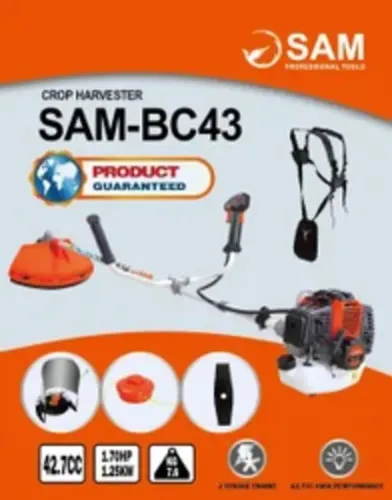
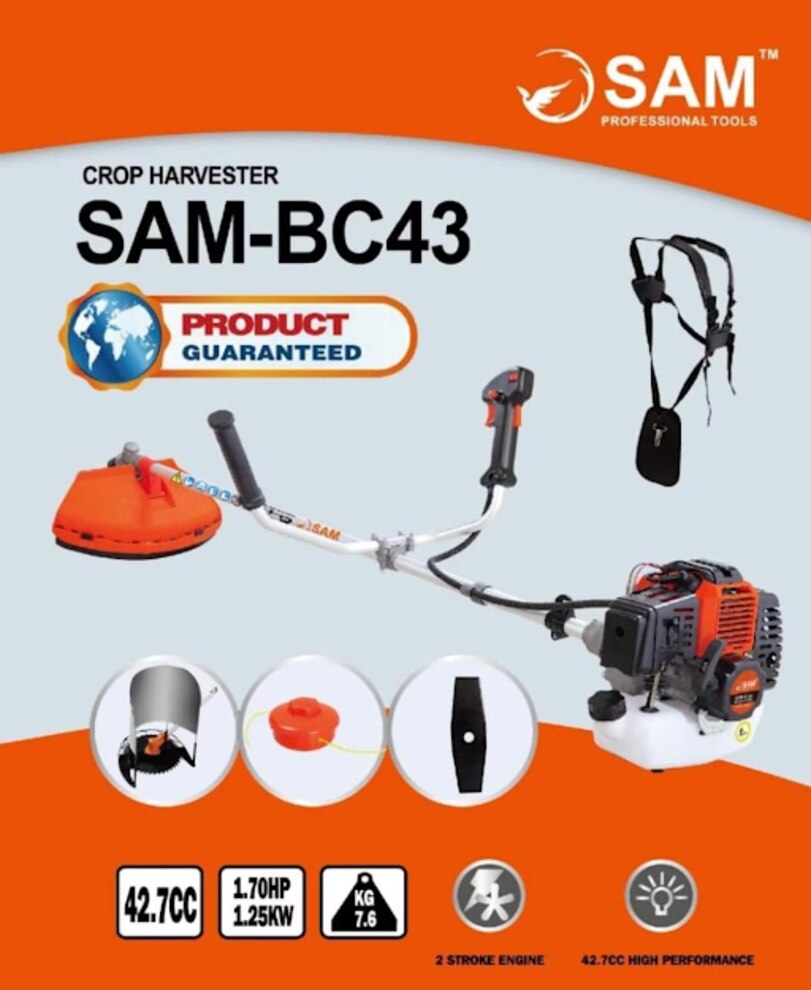
 | GASOLINE BRUSH CUTTER SAM-BC43 2 Stroke Crop Harvester Engine Type: Air Cooled, 2 Stroke Engine Power: 1.25kw/1.7HP Engine Displacement: 42.7cc Fuel Tank Capacity: 1.2Ltr Weight: 7.6kg View product → |
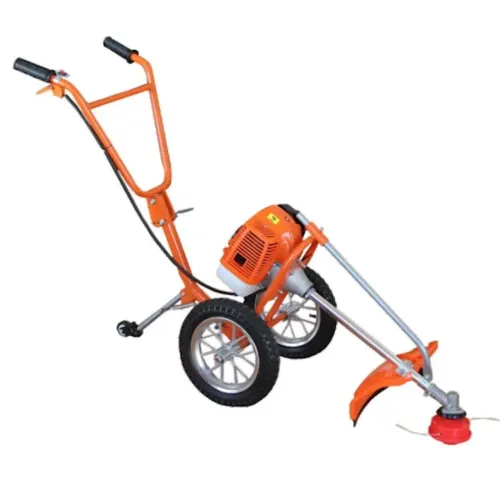
 | GASOLINE BRUSH CUTTER SAM 2 Stroke Wheel Brush Cutter Engine Type: Air Cooled, 2 Stroke Engine Power: 1.4kw/1.9HP Engine Displacement: 51.7cc Fuel Tank Capacity: 1.1Ltr Weight: 10kg View product → |
Frequently asked questions
How do you match a crop harvester to field conditions?
Choose a brush-cutter-style harvester for upright, thin-stemmed crops, then check crop height, stem thickness, row spacing, slope, obstacles and field size before selecting the setup.
What is a repeatable crop-cutting method?
Inspect the machine, enter each row at a controlled speed, keep the cutting attachment aligned with the crop, clear turns safely and shut down using the same sequence after cutting.
How do you estimate a crop harvester's field output?
Use effective field capacity rather than engine power. Base the estimate on cutting width, travel speed and time lost to turning, refuelling, clearing blockages and repositioning.
When should you compare a crop harvester with alternatives?
Compare it with manual cutting and other harvesting tools when labour availability, field access, crop quality, terrain, cutting losses and total operating effort affect the decision.
Related products
 | GASOLINE BRUSH CUTTER SAM-CGX-35 4 Stroke Brush Cutter Engine Type: Air Cooled, 4 Stroke Engine Power: 0.8kw / 1.3HP Engine Displacement: 35.8cc Fuel Tank Capacity: 0.8Ltr Weight: 6.6kg View product → |
 | GASOLINE BRUSH CUTTER HONDA GX-35 4 Stroke Brush Cutter Engine Type: Air Cooled, 4 Stroke Engine Power: 0.8kw/1.3HP Engine Displacement: 35.8cc Fuel Tank Capacity: 0.8Ltr Weight: 6.6kg View product → |
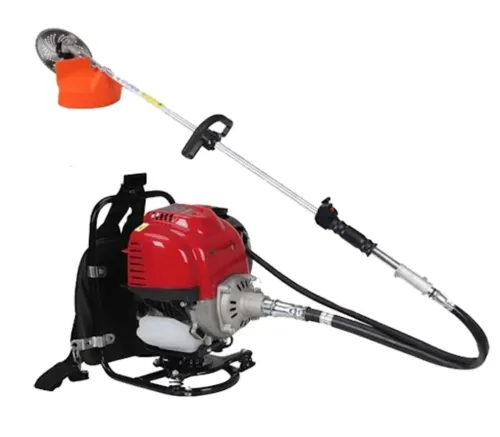
 | GASOLINE BRUSH CUTTER SAM-CGX-35 4 Stroke Backpack Brush Cutter Engine Type: Air Cooled, 4 Stroke Engine Power: 0.8kw / 1.3HP Engine Displacement: 35.8cc Fuel Tank Capacity: 0.8Ltr Weight: 9.5kg View product → |
 | GASOLINE BRUSH CUTTER SAM-143R 2 Stroke Brush Cutter Engine Type: Air Cooled, 2 Stroke Engine Power: 1.6kw/2HP Engine Displacement: 41.5cc Fuel Tank Capacity: 0.75Ltr Weight: 6.5kg View product → |