Choose the cutter around the vegetation, attachment and working conditions—not engine displacement alone. By checking cutting output, fuel and oil requirements, ready-to-work weight, attachment compatibility and safety documentation, you can identify a machine that suits your terrain and workload before comparing suppliers.
Key takeaways
- Match engine output to vegetation thickness and cutting resistance.
- Use a blade, trimmer head and guard designed for the material.
- Compare fuel, oil, maintenance and starting requirements before buying.
- Check ready-to-work weight, balance, controls and safety features.
Match engine output to the vegetation you will cut
Lawn grass and soft weeds need light 4 stroke brush cutter power; thorny brush, saplings and compacted crop residue need more reserve and a stronger gear head.
| Vegetation | Suitable capability | What goes wrong with too little output |
|---|---|---|
| Lawn grass | Light-duty engine with a line head or grass blade | Speed drops and the line welds or tears |
| Soft weeds | Light to medium output with a three-tooth blade | Stems bend instead of cutting cleanly |
| Thorny brush | Higher output, eight-tooth blade and reinforced gear head | Shock loads damage gears and the clutch |
| Saplings | Strong machine with permitted saw blade and robust gear head | A small head overheats or suffers kickback |
| Dense crop residue | High reserve torque and a blade approved for the machine | Compacted material stalls the engine |
Do not judge cutting performance from engine displacement or advertised horsepower alone. Compare rated engine speed, gearbox ratio, maximum attachment speed, permitted blade diameter and power delivered at the blade; clutch slip, blade inertia and gearing determine how much power reaches the cut.
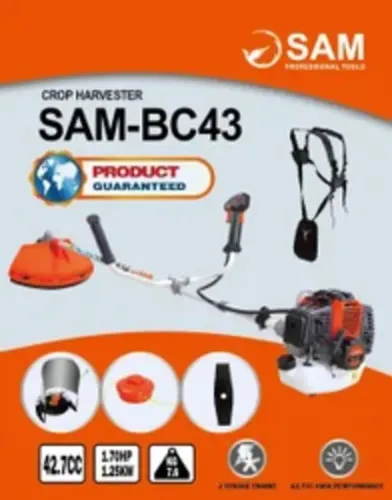
Ask for those figures when comparing the grass and weeds clearing machine 41.5 cc 2-stroke brush cutter with the 51.7 cc 2-stroke brush cutter. More capacity brings higher weight, fuel use and operator fatigue.
A 4-stroke model in this power class is the wrong choice for continuous heavy brush clearing, long carrying distances or steep terrain. For those jobs, compare a stronger machine’s gear head and power-to-weight ratio rather than choosing by engine displacement alone.
Select a cutting attachment that matches the material and guard
Match the cutting head to the vegetation first: a nylon line head suits lawn grass and soft weeds, while a three-tooth grass blade handles taller grass and light weeds. An eight-tooth blade cuts tougher weeds and light brush.
Use a circular saw blade for woody stems and saplings only when the machine, guard and manual permit it.
| Attachment | Suitable material | Why the wrong choice fails |
|---|---|---|
| Nylon line head | Lawn grass and soft weeds | Line breaks or wears rapidly against woody stems |
| Three-tooth grass blade | Tall grass and light weeds | It is not a substitute for a saw blade in dense saplings |
| Eight-tooth blade | Tough weeds and light brush | Excessive resistance can overload an unsuitable gear head |
| Circular saw blade | Woody stems and saplings | A wrong gear head receives severe shock loading and can suffer gear or clutch damage |
Confirm brush cutter attachment compatibility before fitting anything. Check:
- Shaft diameter
- Arbor hole size
- Spindle thread and nut arrangement
- Gearbox connection and locating features
- Permitted blade diameter and attachment speed
- Rotation direction
Use an attachment-specific blade guard. A generic guard supplied with incompatible heads can leave the blade exposed, direct debris at you or fail to contain a broken line. Check the manual and the guard marking against each head; ISO 11806-1 provides a useful safety reference for this machine-and-attachment interface.
Compare four-stroke and two-stroke ownership requirements
Read the fuel instruction before comparing a 4-stroke vs 2-stroke brush cutter. Four-stroke-cycle does not automatically mean straight gasoline: a conventional engine uses gasoline plus separate crankcase oil, while a premix four-stroke design requires its specified gasoline-oil ratio. Confirm the gasoline grade and ethanol limit on the engine manual and machine label.
| Ownership point | Conventional 4-stroke | Conventional 2-stroke |
|---|---|---|
| Lubrication | Check crankcase oil level and follow the oil change interval | Add the specified oil to fuel during fuel preparation |
| Starting behaviour | Usually steadier once warm, but oil level and cold-start controls matter | Often lighter and quick to start when the mixture and carburettor are correct |
| Exhaust smoke | Lower smoke with correct oil level and mixture | More visible smoke and oil smell |
| Vibration and power-to-weight ratio | Smoother running, but heavier because of the crankcase and valve train | Higher power-to-weight ratio for carrying and continuous clearing |
| Maintenance | Oil checks, oil change, valve and air-filter service | Mixture accuracy, air-filter, plug and exhaust service |
| Fuel-system storage | Stale gasoline still gums carburettor passages | Premix separates or degrades and also blocks passages |
A four-stroke suits users who value separate lubrication and lower smoke. A two-stroke suits steep ground, long carrying distances and high-output continuous clearing. Obtain the allowable operating inclination: oil starvation can damage a conventional four-stroke on slopes or unusual orientations.
- Add fuel stabilizer at the label dose before seasonal storage.
- Run the engine long enough to circulate treated fuel, then follow the manual’s tank-draining instruction; drain the carburettor if specified.
Compare ready-to-work weight, balance and operator control
A 6.6 kg brush cutter figure is incomplete until the seller states whether it includes the cutting head, blade, guard, harness, fuel and crankcase oil. Ask for brush cutter working weight in ready-to-work condition, then check its balance point with your chosen attachment and a full tank.
Fuel consumption changes balance as the 0.8 litre fuel tank empties; do not assume runtime from tank size without a fuel-consumption figure. A machine that feels light on paper can still load your wrists if the shaft, attachment and handles pull the blade plane away from neutral.
| Handle system | What to compare | Handling consequence |
|---|---|---|
| Loop handle | Narrower width, grip angle, trigger position and shaft balance | Turns easily in tight areas, but offers less leverage for long side-sweeps |
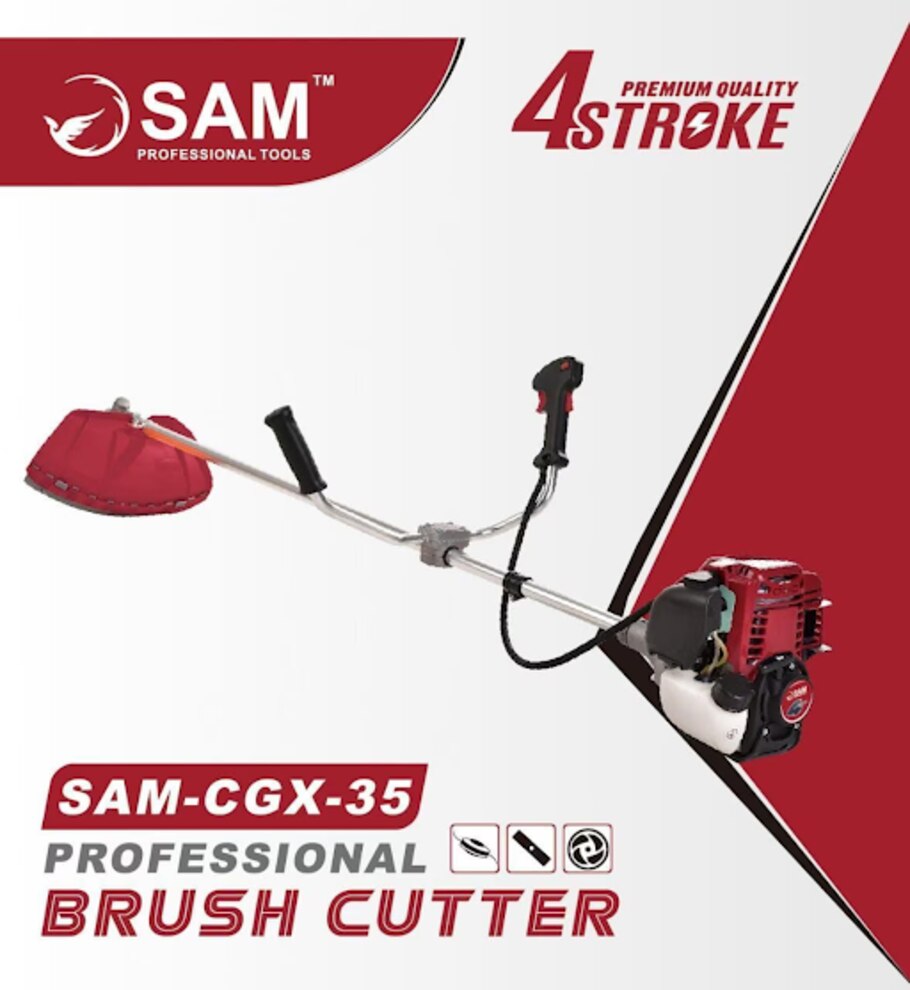
| Bull handle | Wider grip, angled hand positions, trigger reach and blade-plane control | Gives steadier sweeping with a harness when the controls fit your reach |
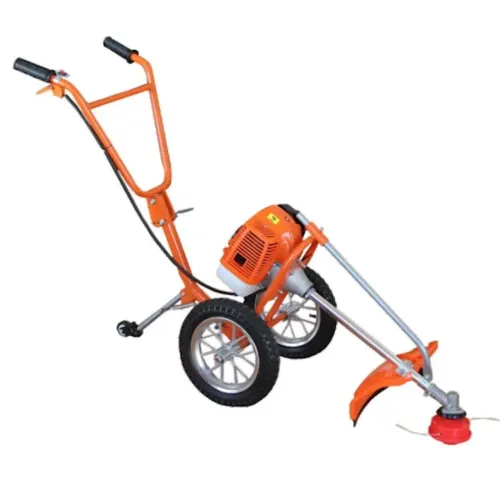
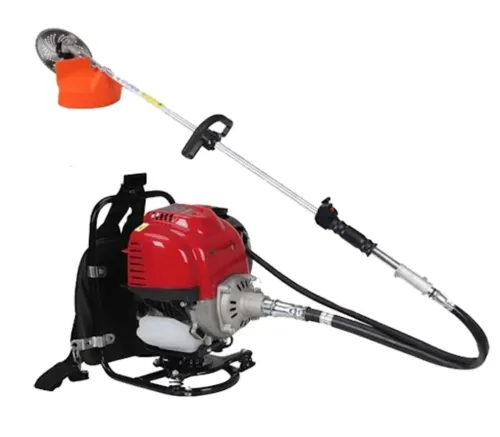
| Backpack brush cutter | Harness transfer, shaft balance and control layout | Moves mass to hips and shoulders for long reaches or slopes, while the shaft remains manoeuvrable |
Require a fitted-harness trial, not a catalogue decision. Test throttle access, shoulder pressure, hip-belt support and whether you can hold the blade level without twisting.
Compare a standard handheld model with a backpack model only after checking contents: a nominal 9.5 kg backpack weight is meaningless if it excludes the hose, harness, head, guard or fuel. Request ISO 22867 vibration results showing test condition, handle position and uncertainty; an unexplained anti-vibration claim cannot predict fatigue.
Use a purchase and acceptance checklist before putting it to work
A durable machine reveals its limits in writing and during a demonstration, not through displacement alone. For brush cutter gear head durability, request:
- Bearing arrangement, seal protection, grease type, greasing interval, permitted blade diameter and maximum attachment speed. A large blade on a small gear head increases shock loading.
- Air filtration for dusty conditions: a washable foam pre-filter or equivalent, a tight filter-cover seal, tool-free inspection and a maintenance interval stated for dusty crops.
- Exact engine variant, attachment list, guard configuration, fuel instructions, service schedule and measurement basis. Importers of Agricultural Equipments should provide these details rather than a generic model name.
At acceptance, run an idle clutch test: the attachment must stay still at governed idle, engage progressively and stop promptly when you release the throttle. Reject a machine that creeps, grabs or coasts excessively.
| Evidence to request | What it proves | Failure if absent |
|---|---|---|
| Operator-ear LpA and machine LWA, separately, with ISO 22868 test configuration | Comparable noise data | A single dB claim hides the measurement |
| Regulation (EU) 2016/1628 engine type approval or engine-family identification and emissions label | Traceable emissions compliance | “Stage V” alone proves nothing |
| Directive 2000/14/EC guaranteed LWA and conformity documents | Outdoor-noise conformity | No verified legal noise marking |
For EU sales, match every document to the supplied engine and attachment configuration. A catalogue listing without these records is not acceptance evidence.
Related products
 | GASOLINE BRUSH CUTTER SAM-CGX-35 4 Stroke Brush Cutter Engine Type: Air Cooled, 4 Stroke Engine Power: 0.8kw / 1.3HP Engine Displacement: 35.8cc Fuel Tank Capacity: 0.8Ltr Weight: 6.6kg View product → |
 | GASOLINE BRUSH CUTTER HONDA GX-35 4 Stroke Brush Cutter Engine Type: Air Cooled, 4 Stroke Engine Power: 0.8kw/1.3HP Engine Displacement: 35.8cc Fuel Tank Capacity: 0.8Ltr Weight: 6.6kg View product → |
Frequently asked questions
How do I match brush cutter engine output to the vegetation?
Use a lighter machine for lawn grass and soft weeds. Choose more engine reserve and a stronger gear head for thorny brush, saplings and compacted crop residue.
Which cutting attachment should I choose?
Use nylon line for grass, a suitable blade for heavier weeds and brush, and a blade-and-guard combination approved for the machine. Match the attachment to the material and never remove the guard.
What ownership differences matter between four-stroke and two-stroke brush cutters?
A four-stroke model uses separate petrol and engine oil, while a two-stroke model uses the manufacturer-specified petrol-oil mixture. Compare refuelling, oil checks, maintenance and starting procedures.
What should I check before accepting a brush cutter?
Check the model and serial number, engine starting, throttle and stop switch, shaft and gear head, cutting attachment, guard, harness, fasteners, fuel and oil leaks, and the supplied manual.
Related product
 | GASOLINE BRUSH CUTTER SAM-CGX-35 4 Stroke Backpack Brush Cutter Engine Type: Air Cooled, 4 Stroke Engine Power: 0.8kw / 1.3HP Engine Displacement: 35.8cc Fuel Tank Capacity: 0.8Ltr Weight: 9.5kg View product → |